
Remarks by Chairman Ben S. BernankeBefore the Economic Club of Chicago, Chicago, IllinoisJune 15, 2006 Energy and the Economy In my remarks today, I would like to discuss the relationship between energy markets and the economy. As I am certain all of you are aware, the steep increases in energy prices over the past several years have had significant consequences for households, businesses, and economic policy. At least since the time of the first oil shock in October 1973, economists have struggled to understand the ways that disturbances to the supply and demand balance in energy markets influence economic growth and inflation. At the most basic level, oil and natural gas are just primary commodities, like tin, rubber, or iron ore. Yet energy commodities are special, in part because they are critical inputs to a very wide variety of production processes of modern economies. They provide the fuel that drives our transportation system, heats our homes and offices, and powers our factories. Moreover, energy has an influence that is disproportionate to its share in real gross domestic product (GDP) largely because of our limited ability to adjust the amount of energy we use per unit of output over short periods of time. Over longer periods, energy consumption can be altered more easily by, for example, adjusting the types of vehicles that we drive, the kind of homes that we build, and the variety of machines that we buy. Those decisions, in turn, influence the growth and composition of the stock of capital and the productive capacity of the economy.Over the past thirty-five years, the U.S. economy has experienced some wide swings in energy prices. The oil price increases of the 1970s were followed by price declines in the mid-1980s and then a price spike in 1990, with numerous fluctuations since then. From the mid-1980s until fairly recently, market participants tended to look through these price cycles and did not allow their longer-term expectations for oil prices to be greatly affected by short-run swings in spot prices. But beginning around 2003, futures prices began moving up roughly in line with the rise in spot prices. Thus, unlike in earlier episodes, the significantly higher relative price of energy that we are now experiencing is expected to be relatively long lasting and thus will likely prompt more-significant adjustments by households and businesses over time.This higher relative price of energy poses many important questions for economists and policymakers. Why have the prices of oil and natural gas risen so much? What is the outlook for energy supplies and prices in the medium term and in the long term? And what implications does the behavior of energy prices have for the ongoing economic expansion and inflation? I will touch briefly on each of these questions. Developments in Oil MarketsLet me begin with the market for crude oil. What accounts for the behavior of the current and expected future prices of petroleum? Supply and demand are among the most valuable concepts in the economist's toolkit, and I believe they are the key to understanding recent and prospective developments in oil markets. For the most part, high oil prices reflect high and growing demand for oil and limited and uncertain supplies. On the demand side, world oil consumption surged 4 percent in 2004 after rising a solid 2 percent in 2003. The rise in 2004 was much larger than had been expected and was, in fact, the largest yearly increase in a quarter-century. A significant part of the unexpected increase in oil consumption that year reflected rapidly growing oil use in the United States and East Asia, notably China. In 2005, growth of world oil consumption slowed to 1.3 percent, partly reflecting the restraining effects of higher prices. Nonetheless, the level of oil consumption was still high relative to earlier expectations. Thus far this year, underlying demand pressures have remained strong in the context of a global economy that has continued to expand robustly. On the supply side, the production of oil has been constrained by available capacity, hurricanes, and geopolitical developments. In 2003 and 2004, as oil consumption and prices rose briskly, Saudi Arabia and other members of the Organization of the Petroleum Exporting Countries (OPEC) pumped more oil. OPEC was able to boost production relatively quickly in response to changing market conditions by utilizing productive capacity that had been idle. By the end of 2004, however, OPEC's spare production capacity was greatly diminished. As a consequence, OPEC's oil production flattened out over the past year even as oil prices continued to soar.Oil production outside OPEC also leveled off last year, contrary to earlier expectations for continued growth. This development in part reflected the devastating effects of last year's hurricanes. Katrina and Rita were enormously disruptive for our nation's production of energy. At the worst point, 1.5 million barrels per day of crude oil were shut in, virtually all of the U.S. production in the Gulf of Mexico and nearly 2 percent of global oil production. Recovery of oil production in the Gulf has been slow, and the disruptions from last year's storms linger even as we enter this year's hurricane season. The cumulative loss in oil production attributable to Katrina and Rita amounts to more than 160 million barrels of oil, a figure equivalent to nearly half the present level of commercial crude oil inventories in the United States. With the background of strong demand and limited spare capacity, both actual production disruptions and concerns about the reliability and security of future oil supplies have contributed to the volatility in oil prices. The oil-rich Middle East remains an especially unsettled region of the world, but political risks to the oil supply have also emerged in nations outside the Middle East, including Russia, Venezuela, and Nigeria. Compounding these difficulties in markets for crude oil have been constraints and disruptions in the refining sector of the energy industry. In the wake of Hurricane Rita, one-quarter of domestic refining capacity was offline, and here, too, the period of recovery has been protracted. Even before last year's hurricanes, however, a mismatch appeared to be emerging between the incremental supply of crude oil, which tended to be heavy and sulfurous, and the demand by refiners for light, sweet crude, which can be converted more easily into clean-burning transportation fuels. These developments have highlighted the need for additional investments in refining capacity to bridge the gap between upstream supply and final demand. What about the longer term? We can safely assume that world economic growth, together with the rapid pace of industrialization in China, India, and other emerging-market economies, will generate increasing demand for oil and other forms of energy. In all likelihood, growth in the demand for energy will be tempered to some extent by continued improvements in energy efficiency which, in turn, will be stimulated by higher prices and ongoing concerns about the security of oil supplies. Such improvements are possible even without technological breakthroughs. For example, Japan is an advanced industrial nation that uses only about one-half as much energy to produce a dollar's worth of real output as the United States does. Of course, the Japanese and U.S. economies differ in important ways, but the comparison nevertheless suggests that there is scope to boost energy efficiency in the United States and other parts of the industrialized world. Newly industrializing economies such as China appear to be quite inefficient in their use of energy; but as they modernize, they can adopt energy-saving techniques already in use elsewhere, and their energy efficiency will presumably improve as well.Still, as the global economic expansion continues, substantial growth in the use of oil and other energy sources appears to be inevitable. How readily the supply side of the oil market will respond is difficult to predict. In a physical sense, the world is not in imminent danger of running out of oil. At the end of 2005, the world's proved reserves of conventional oil--that is, oil in the ground that is viewed as recoverable using existing technologies and under current economic conditions--stood at more than 1.2 trillion barrels, about 15 percent higher than the world's proved reserves a decade earlier and equal to about four decades of global consumption at current rates. These figures do not include Canada's vast deposits of oil sands, which are estimated to contain an additional 174 billion barrels of proved reserves. In addition, today's proved reserve figures ignore not only the potential for new discoveries but also the likelihood that improved technologies and higher oil prices will increase the amount of oil that can be economically recovered.The oil is there, but whether substantial new sources of production can be made available over the next five years or so is in some doubt. Some important fields are in locations that are technically difficult and time-consuming to develop, such as deep-water fields off the coast of West Africa, in the Gulf of Mexico, or off the east coast of South America. In many cases, the development of new fields also faces the challenge of recovering the oil without damaging delicate ecosystems. Perhaps most troubling are the significant uncertainties generated by geopolitical instability, as I have already noted. Much of the world's oil reserves are located in areas where political turmoil and violence have restrained both production and investment.In both the developed and the developing world, another factor holding back investment in oil infrastructure has been concern on the part of producers that oil prices might fall back as they did in the 1980s and 1990s. In light of that recognition, some oil producers have been reluctant to launch exploration projects even with today's high prices. Such concerns have been reinforced by the huge reserves of oil in several OPEC countries that could be extracted at very low cost if sufficient resources and expertise were directed toward doing so.Developments in the Natural Gas MarketThe story for natural gas shares some similarities with the story for oil, but there are important differences as well. In the 1990s, the U.S. spot price of natural gas at the Henry Hub averaged about $2 per million Btu. However, in recent years, the United States has seen a marked increase in the price of natural gas. The average spot price climbed to nearly $9 per million Btu in 2005, with the price spiking to $15 per million Btu following hurricanes Katrina and Rita. So far this year, natural gas prices have fallen back to around $7 per million Btu as an unusually warm winter curtailed consumption and boosted natural gas in storage to record levels. Futures markets currently anticipate that the price of natural gas will be about $9 per million Btu next year.Why have natural gas prices risen so sharply over the past few years, and why are they expected to remain elevated? As with oil, high prices of natural gas reflect strong demand and diminished supplies. Unlike the globally integrated market for oil, however, natural gas markets are regional, primarily because of the difficulty in transporting gas by means other than pipelines. Although the world's capacity to trade liquefied natural gas, which is transported by ships, is growing, it is still a small fraction of world supply and is not yet sufficient to fully integrate natural gas markets across continents. Demand for natural gas in North America has remained strong in recent years, particularly as environmental concerns have led clean-burning natural gas to become the fuel of choice for new electricity generation. Moreover, increases in oil prices have boosted the demand for energy substitutes such as natural gas. However, domestic production of natural gas has not kept up. Last year, U.S. production was 7 percent below its 2001 level, with less than half of that decline reflecting the impact of hurricanes Katrina and Rita.Increased trade can often mitigate price increases, but net imports of natural gas from Canada, which currently account for around 16 percent of U.S. consumption, have failed to increase in response to higher prices. Between 1988 and 2001, net imports from Canada tripled, but they have since flattened out. Both U.S. and Canadian gas fields have matured and are yielding smaller increases in output, despite the incentive of high prices and a substantial increase in the number of drilling rigs in operation.Trade in liquefied natural gas, or LNG, is also likely to increase over time, but perhaps at a slower pace than once envisioned. LNG imports into the United States nearly tripled from 2002 to 2004, but they actually fell a bit last year as production disruptions in a number of countries limited supply and as consumers in other countries competed for available cargoes.Thus, natural gas prices are likely to remain elevated for at least the coming few years. It is possible, however, that within a decade new supplies from previously untapped areas of North America could boost available output here, while imports of LNG will increase to more substantial levels as countries seek to bring their isolated natural gas reserves to market. Given time, these developments could serve to lower natural gas prices in the United States significantly. Nonetheless, because of the higher costs of producing these supplies relative to the traditional sources of natural gas, as well as the elevated cost of other energy sources such as oil, natural gas prices seem unlikely to return to the level of the 1990s.Thus, the supply-demand fundamentals seem consistent with the view now taken by market participants that the days of persistently cheap oil and natural gas are likely behind us. The good news is that, in the longer run, we have options. I have already noted the scope for improvements in energy efficiency and increased conservation. Considerable potential exists as well for substituting other energy sources for oil and natural gas, including coal, nuclear energy, and renewable sources such as bio-fuels and wind power. Given enough time, market mechanisms are likely to increase energy supplies, including alternative energy sources, while simultaneously encouraging conservation and substitution away from oil and natural gas to other types of energy. Economic and Policy Implications of Increased Energy PricesWhat are the economic implications of the higher energy prices that we are experiencing? In the long run, higher energy prices are likely to reduce somewhat the productive capacity of the U.S. economy. That outcome would occur, for example, if high energy costs make businesses less willing to invest in new capital or cause some existing capital to become economically obsolete. All else being equal, these effects tend to restrain the growth of labor productivity, which in turn implies that real wages and profits will be lower than they otherwise would have been. Also, the higher cost of imported oil is likely to adversely affect our terms of trade; that is, Americans will have to sell more goods and services abroad to pay for a given quantity of oil and other imports. For the medium term at least, the higher bill for oil imports will increase the U.S. current account deficit, implying a greater need for foreign financing.Under the assumption that energy prices do not move sharply higher from their already high levels, these long-run effects, though clearly negative, appear to be manageable. The U.S. economy is remarkably flexible, and it seems to have absorbed the cost shocks of the past few years with only a few dislocations. And conservation and the development of alternative energy sources will, over the long term, ameliorate some of the effects of higher energy prices. Moreover, ongoing productivity gains arising from sources such as technological improvements are likely to exceed by a significant margin the productivity losses created by high energy prices.In the short run, sharply higher energy prices create a rather different and, in some ways, a more difficult set of economic challenges. Indeed, a significant increase in energy prices can simultaneously slow economic growth while raising inflation.An increase in oil prices slows economic growth in the short run primarily through its effects on consumer spending. Because the United States imports much of the oil that it consumes, an increase in oil prices is, as many economists have noted, broadly analogous to the imposition of a tax on U.S. residents, with the revenue from the tax going to oil producers abroad. In 2004 as a whole, the total cost of imported oil increased almost $50 billion relative to 2003. The imported oil bill jumped again last year by an additional $70 billion, and given the price increases we have experienced in 2006, it appears on track to increase $50 billion further at an annual rate in the first half of this year. Coupled with the rising cost of imported natural gas, the cumulative increase in imported energy costs since the end of 2003 is shaping up to be $185 billion--equal to almost 1-1/2 percent of GDP. All else being equal, this constitutes a noticeable drag on real household incomes and spending. It is a tribute to the underlying strength and resiliency of the U.S. economy that it has been able to perform well despite the drag from increased energy prices.At the same time that higher oil prices slow economic growth, they also create inflationary pressures. Higher prices for crude oil are passed through to increased prices for the refined products used by consumers, such as gasoline and heating oil. When oil prices rise, people may try to substitute other forms of energy, such as natural gas, leading to price increases in those alternatives as well. The rise in prices paid by households for energy--for example for gasoline, heating oil, and natural gas--represent, of course, an increase in the cost of living and in price inflation. This direct effect of higher energy prices on the cost of living is sometimes called the first-round effect on inflation. In addition, higher energy costs may have indirect effects on the inflation rate--if, for example, firms pass on their increased costs of production in the form of higher consumer prices for non-energy goods or services or if workers respond to the increase in the cost of living by demanding higher nominal wages. A jump in energy costs could also increase the public's longer-term inflation expectations, a factor that would put additional upward pressure on inflation. These indirect effects of higher energy prices on the overall rate of inflation are called second-round effects.The overall inflation rate reflects both first-round and second-round effects. Economists and policymakers also pay attention to the so-called core inflation rate, which excludes the direct effects of increases in the prices of energy (as well as of food). By stripping out the first-round inflation effects, core inflation provides a useful indicator of the second-round effects of increases in the price of energy.In the past, notably during the 1970s and early 1980s, both the first-round and second-round effects of oil-price increases on inflation tended to be large, as firms freely passed on rising energy costs to consumers, workers reacted to the surging cost of living by ratcheting up their wage demands, and longer-run expectations of inflation moved up quickly. In this situation, monetary policymaking was extremely difficult because oil-price increases threatened to result in a large and persistent increase in the overall inflation rate. The Federal Reserve attempted to contain the inflationary effects of the oil-price shocks by engineering sharp increases in interest rates, actions which had the consequence of sharply slowing growth and raising unemployment, as in the recessions that began in 1973 and 1981.Since about 1980, however, the Federal Reserve and most other central banks have worked hard to bring inflation and expectations of inflation down. An important benefit of these efforts is that the second-round inflation effect of a given increase in energy prices has been much reduced. To the extent that households and business owners expect that the Fed will keep inflation low, firms have both less incentive and less ability to pass on increased energy costs in the form of higher prices, and likewise workers have less incentive to demand compensating increases in their nominal wages.As I noted in remarks last week, although the rate of pass-through of higher energy and other commodity prices to core consumer price inflation appears to have remained relatively low in the current episode--reflecting the inflation-fighting credibility built by the Fed in recent decades the cumulative increases in energy and commodity prices have been large enough that they could account for some of the recent pickup in core inflation. In addition, some survey-based measures of longer-term inflation expectations have edged up, on net, in recent months, as has the compensation for inflation and inflation risk implied by yields on nominal and inflation-indexed government debt. As yet, these expectations measures have remained within the ranges in which they have fluctuated in recent years and inflation compensation implied by yields on government debt has fallen back somewhat in the past month. Nevertheless, these developments bear watching.In conclusion, energy prices have moved up considerably since the end of 2002, reflecting supply and demand factors. In the short run, prices are likely to remain high in an environment of strong world economic growth and a limited ability to increase energy supplies. Moreover, prices are likely to be volatile in the near term, given the small margins of excess capacity to produce crude oil or natural gas that traditionally have buffered short-run shifts in supply and demand. However, in the long run, market forces will respond. The higher relative prices of energy will create incentives for businesses to create new, energy-saving technologies and for energy consumers to adopt them. The market for alternative fuels is growing rapidly and will help to shift consumption away from petroleum-based fuels. Government can contribute to these conservation efforts by working to create a regulatory environment that encourages the growth in energy supplies in a manner that is consistent with our nation's environmental and other objectives. Given the extraordinary resilience of the U.S. economy, I am confident our nation will be up to this challenge.

[관련키워드]




[뉴스핌 베스트 기사]
 사진
사진
靑 "원포인트 개헌 반대 안해"
[서울=뉴스핌] 김미경 박찬제 기자 = 청와대는 3일 한병도 더불어민주당 원내대표의 '원포인트 헌법개정' 제안에 "사전 교감은 없었지만 반대하지는 않는다"는 입장을 밝혔다.
청와대 고위 관계자는 이날 뉴스핌에 "(당청 사이에) 특별한 교감이 있었던 것은 아니다"면서 "다만 오래전부터 원포인트 개헌에는 공감대가 있었다"고 말했다.
이 관계자는 "이재명 대통령도 공약 사항으로 개헌을 언급했다"면서 "한 번에 전면 개헌을 하기 어렵다면 중요한 것이라도 먼저 개헌하자고 했다"고 설명했다.
청와대 전경. [사진=뉴스핌DB]
한 원내대표는 이날 임시국회 교섭단체 대표 연설에서 "오는 지방선거와 함께 원포인트 개헌을 제안한다"며 "5·18 정신을 헌법 전문에 수록하자"고 야당에 촉구했다.
한 원내대표는 "5·18민주화운동은 대한민국 헌정질서와 민주주의의 근간"이라면서 "헌법 전문 수록을 더 이상 미룰 이유가 없다. 야당의 초당적인 협조를 기대한다"고 거듭 야당에 요청했다.
청와대 고위 관계자는 "5·18민주화운동 전문 수록이나 비상계엄 요건 강화 등이 대표적인 개헌 의제"이라면서 "개헌을 하려면 국회 200석 이상 찬성이 있어야 하기 때문에 논의가 필요하다"고 전제했다.
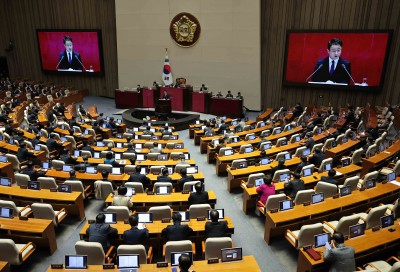
[서울=뉴스핌] 윤창빈 기자 = 한병도 더불어민주당 원내대표가 3일 서울 여의도 국회에서 열린 본회의에서 국정에 관한 교섭단체 대표연설을 하고 있다. 2026.02.03 pangbin@newspim.com
청와대 고위 관계자는 "청와대는 우선 국회 논의를 두고보자는 입장"이라면서 "국회 논의가 잘 이뤄지길 바란다는 정도가 청와대 입장"이라고 말했다.
이재명 정부는 국정과제 1호로 '개헌'을 제시했지만 아직은 개헌에 필요한 특별한 움직임은 보이지 않고 있다.
다만 시기적으로 정권 초기에 치러지는 오는 6·3 지방선거를 계기로 개헌 추진에 시동을 걸어보겠다는 의지로 읽힌다.
이재명 정부의 국정 수행 지지율이 나쁘지 않고 국정 장악력이 강하고 정권 초기라는 잇점이 있다. 하지만 개헌 카드는 양날의 칼이기도 하다.
국정 동력은 물론 개혁 과제 추진에 적지 않은 부담이 아닐 수 없다. 개헌 카드는 모든 이슈를 빨아들이는 블랙홀이 될 수 있어 이재명 정부가 실제로 이번 지방선거에서 개헌을 강하게 밀어붙일지 주목된다.
이날 청와대 고위 관계자의 발언은 일단 여당이 애드벌룬을 띄워놓고 국회 진전 상황과 정국의 흐름을 봐 가면서 무리하지 않게 추진하겠다는 의도로 보인다.
pcjay@newspim.com
2026-02-03 12:37
 사진
사진
'법정소란' 이하상 변호사 감치 집행
[서울=뉴스핌] 홍석희 기자 = 한덕수 전 국무총리 재판에서 법정 소란으로 감치 명령을 받은 김용현 전 국방부 장관 측 변호인이 3일 구금됐다.
이날 서울중앙지법 형사합의34부(재판장 한성진) 심리로 열린 김 전 장관의 위계공무집행방해 혐의 재판 종료 직후, 김 전 장관 측 변호인으로 출석한 이하상 변호사에 대한 감치 명령이 집행됐다.
한덕수 전 국무총리 재판에서 법정 소란으로 감치 명령을 받은 김용현 전 국방부 장관 측 변호인이 3일 구금됐다. 사진은 김용현 전 국방부 장관 변호인 이하상 변호사가 지난해 6월 25일 서울 서초구 서울중앙지법에서 열린 김 전 장관의 구속영장 심문기일에 출석하는 모습. [사진=뉴스핌 DB]
재판이 끝난 이후 법무부 교정본부 직원들이 이 변호사의 신병을 확보한 것으로 알려졌다. 이 변호사는 법원 구치감에 머무르다 서울구치소로 옮겨졌다. 감치 기간은 총 15일이다.
지난해 11월 한 전 총리 재판부인 서울중앙지법 형사합의33부(재판장 이진관)는 김 전 장관에 대한 증인신문 당시 퇴정 명령에 응하지 않은 이 변호사와 권우현 변호사에 대해 감치 15일을 선고했다.
하지만 인적 사항이 특정되지 않았다는 이유로 교정당국이 수용을 거절하면서 집행정지로 풀려났다. 이후 이들은 감치 결정에 항고했으나 서울고법도 받아들이지 않았으며, 권 변호사의 경우 감치 5일을 추가로 선고받았다.
hong90@newspim.com
2026-02-03 17:07